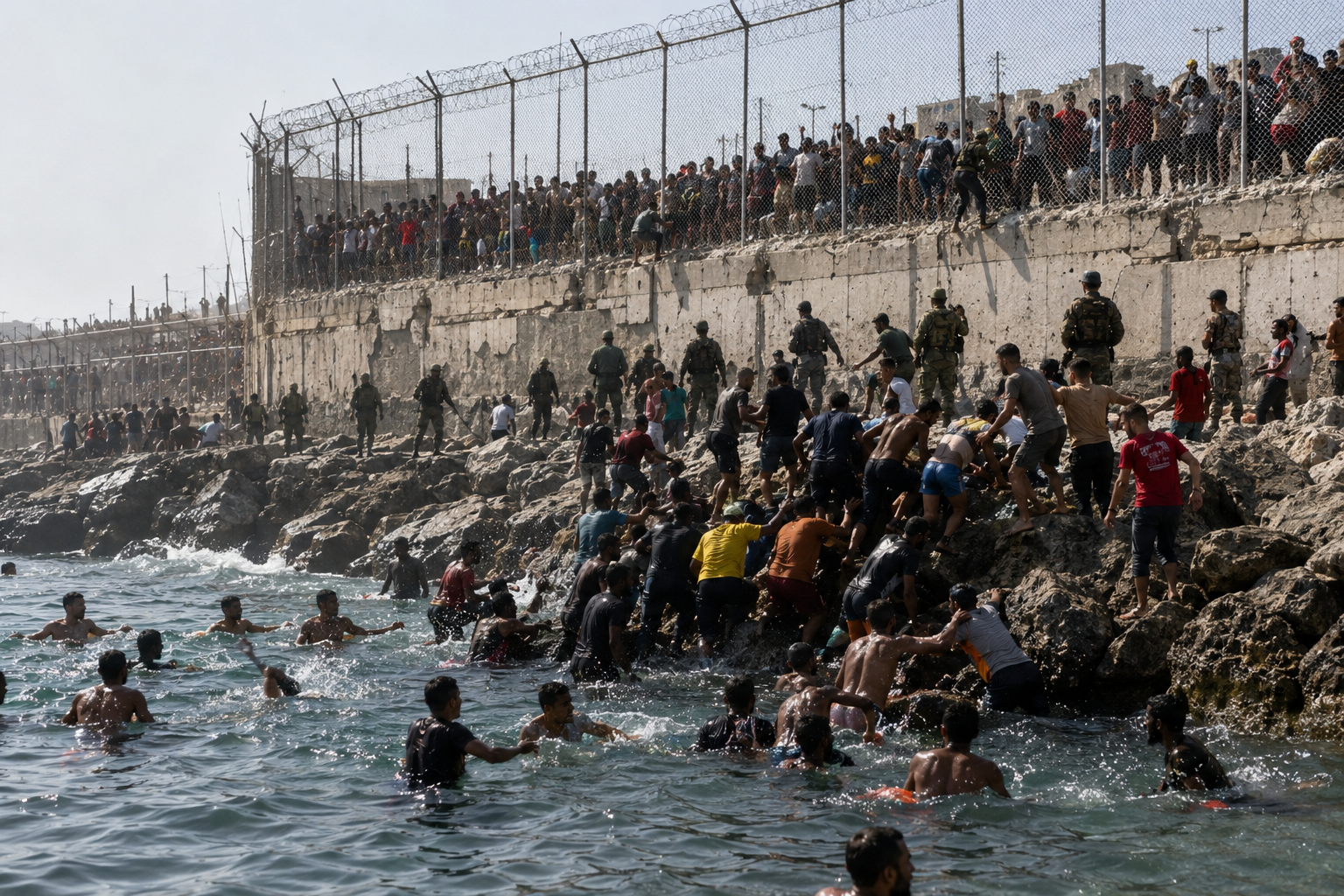
CEUTA, Spain — Spanish and Moroccan authorities have released substantially different estimates of the number of people who crossed into Ceuta, leaving the full scale of the border breach unresolved.
Spain’s Interior Ministry estimated that approximately 50,000 people crossed from Morocco beginning July 30. Juan Jesús Vivas, president of Ceuta’s local government, separately estimated that as many as 60,000 people entered over two days. Morocco’s Interior Ministry later placed the number at approximately 40,000. No complete, independently verified count has been released (Benassatto, 2026; Gore & Eljechtimi, 2026).
The Spanish government’s representative in Ceuta, Miguel Ángel Pérez, said Sunday that at least 72 people had died on the Spanish side of the border and that more than 1,000 people had received medical treatment. Five bodies included in that total were recovered Sunday along the coast (Benassatto, 2026).
Spanish authorities said some victims drowned while attempting to reach Ceuta by sea. Others were crushed as crowds attempted to cross the Tarajal breakwater and border fencing (Benassatto, 2026).
Morocco’s Interior Ministry separately reported 11 deaths, most of them from drowning. The ministry said it was reviewing reports concerning deaths recorded on the Spanish side. It was not immediately clear whether Morocco’s figure was separate from Spain’s total or included some of the same victims. The two figures therefore should not be combined into a confirmed overall death toll (Benassatto, 2026; Naishadham, 2026).
Spanish officials said more than 48,000 people returned to Morocco within 48 hours. The Interior Ministry estimated that 48,300 had returned by 6 p.m. Friday. Additional people returned during the weekend, but authorities had not published a final count of those who remained in Ceuta (Gore & Eljechtimi, 2026).
Some of those who remained were staying in the hills surrounding the city, on beaches or near a temporary reception center. Spanish authorities also continued searching coastal waters for bodies (Naishadham, 2026).
Ceuta has approximately 84,000 residents. At the Interior Ministry’s estimate of 50,000 arrivals, the number entering during the crisis was equal to nearly 60 percent of the territory’s regular population. At Vivas’ estimate of 60,000, the arrivals were equal to approximately 71 percent of the resident population (Gore & Eljechtimi, 2026; Naishadham, 2026).
Spain Installs New Barrier After Court Decision
Spain began installing a pneumatic barrier and anchored naval buoys at the Tarajal breakwater Saturday. Authorities said the system could extend approximately 500 meters, rise between 30 and 70 centimeters above the water and reach as much as one meter beneath the surface. A channel was left open for Civil Guard patrol vessels (Pons & Gore, 2026).
Spanish Interior Minister Fernando Grande-Marlaska linked the new barrier to a recent Spanish Supreme Court ruling. He said migrant-smuggling networks had circulated misleading interpretations of the decision, which restricted the immediate return of migrants intercepted at sea when no physical barrier had been crossed (Pons & Gore, 2026).
The ruling did not grant migrants who reached Ceuta an automatic right to remain in Spain. It prevented immediate returns under the border-rejection procedure in those circumstances but did not prohibit returns carried out through ordinary legal processes (Waldersee & Eljechtimi, 2026).
Prime Minister Pedro Sánchez described the crossing as a “violation of Spanish sovereignty” and said the government would seek to return those who had no legal right to remain in the country (Waldersee & Eljechtimi, 2026, “False Information” section, para. 1).
Morocco’s Interior Ministry attributed the crossing to misinformation on social media, trafficking networks and misunderstandings concerning the Spanish court ruling. Spain’s Foreign Ministry offered a similar assessment. Those explanations represent the positions of the two governments; no independent investigation has established a single cause for the movement (Benassatto, 2026).
Interviews conducted by Reuters indicated that videos and messages posted online influenced some people’s decisions to travel toward Ceuta. Migrants also cited poverty, inadequate wages, poor public services and limited economic opportunities as reasons for attempting the crossing (Waldersee & Eljechtimi, 2026).
Italy Introduces Checks on Arrivals From Spain
Italy announced Friday that it would temporarily reintroduce border controls on air and sea connections with Spain for one month (Reuters, 2026).
The Italian government said the measure would involve targeted checks on non-European Union nationals arriving from Spain. Spanish citizens and citizens of other EU countries would not be affected in the same manner. Italy and Spain do not share a land border (Reuters, 2026).
Italian Prime Minister Giorgia Meloni called the decision an “extraordinary measure” intended to protect national security and prevent possible consequences for Italy. She said the controls would remain only as long as necessary and that the government would seek to limit disruption to summer tourism (Reuters, 2026, paras. 3–4).
Italy also said it had reached an agreement with France to strengthen monitoring along the French-Italian border. At the time of the announcement, Italian authorities had not reported evidence of substantial movement toward Italy by people who had entered Ceuta (Reuters, 2026).
Piero De Luca, a senior member of Italy’s opposition Democratic Party, accused Meloni’s government of introducing the controls for domestic political purposes. The Italian government maintained that the measure was a security precaution (Reuters, 2026).
Sánchez criticized Italy’s response in a letter to European leaders, calling it a “selfish, polarising and unlawful reaction” (Pons & Gore, 2026, “EU Calls Emergency Meeting” section, para. 4).
The Schengen system generally permits travel between participating countries without routine internal border inspections. Member states may temporarily restore border controls when they identify a serious threat to public order or national security (Reuters, 2026).
Representatives of 22 European Union countries requested coordinated action following the Ceuta crossing. Ireland, which holds the rotating EU presidency, scheduled an emergency video conference of interior ministers to discuss the situation (Pons & Gore, 2026).
The figures remain subject to revision. Spain’s Interior Ministry estimated approximately 50,000 entries, Ceuta’s president estimated as many as 60,000 and Morocco reported approximately 40,000. Spanish officials confirmed at least 72 deaths on their side of the border. Morocco separately reported 11 deaths, although officials had not established whether those deaths were additional to Spain’s total (Benassatto, 2026; Gore & Eljechtimi, 2026).
References
Benassatto, L. (2026, August 2). Death toll from migrant rush into Spanish enclave in North Africa rises to 72. Reuters.
Gore, M. F., & Eljechtimi, A. (2026, July 31). Spain says migrants are returning from Ceuta after 57 die in border rush. Reuters.
Naishadham, S. (2026, August 2). Ceuta grapples with aftermath of border surge after most migrants leave the Spanish territory. Associated Press.
Pons, C., & Gore, M. F. (2026, August 1). Spain installs floating barrier in Ceuta after deadly migrant rush. Reuters.
Reuters. (2026, July 31). Italy reimposes border controls on Spain after Ceuta migrant surge.
Waldersee, V., & Eljechtimi, A. (2026, July 31). Social media rumours, economic hardship fuel migrant surge into Ceuta. Reuters.